EAD Card Mortgage: Everything Non-Permanent Residents Need to Know
Your Employment Authorization Document — the plastic card in your wallet that says you’re legally allowed to work in the United States — is not a barrier to homeownership.
But depending on which type of EAD you have, the mortgage process ranges from “pretty straightforward” to “you really need the right lender.” This guide breaks down each EAD category, the mortgage rules that apply, and how to maximize your approval chances.
What Is an EAD and Who Has One?
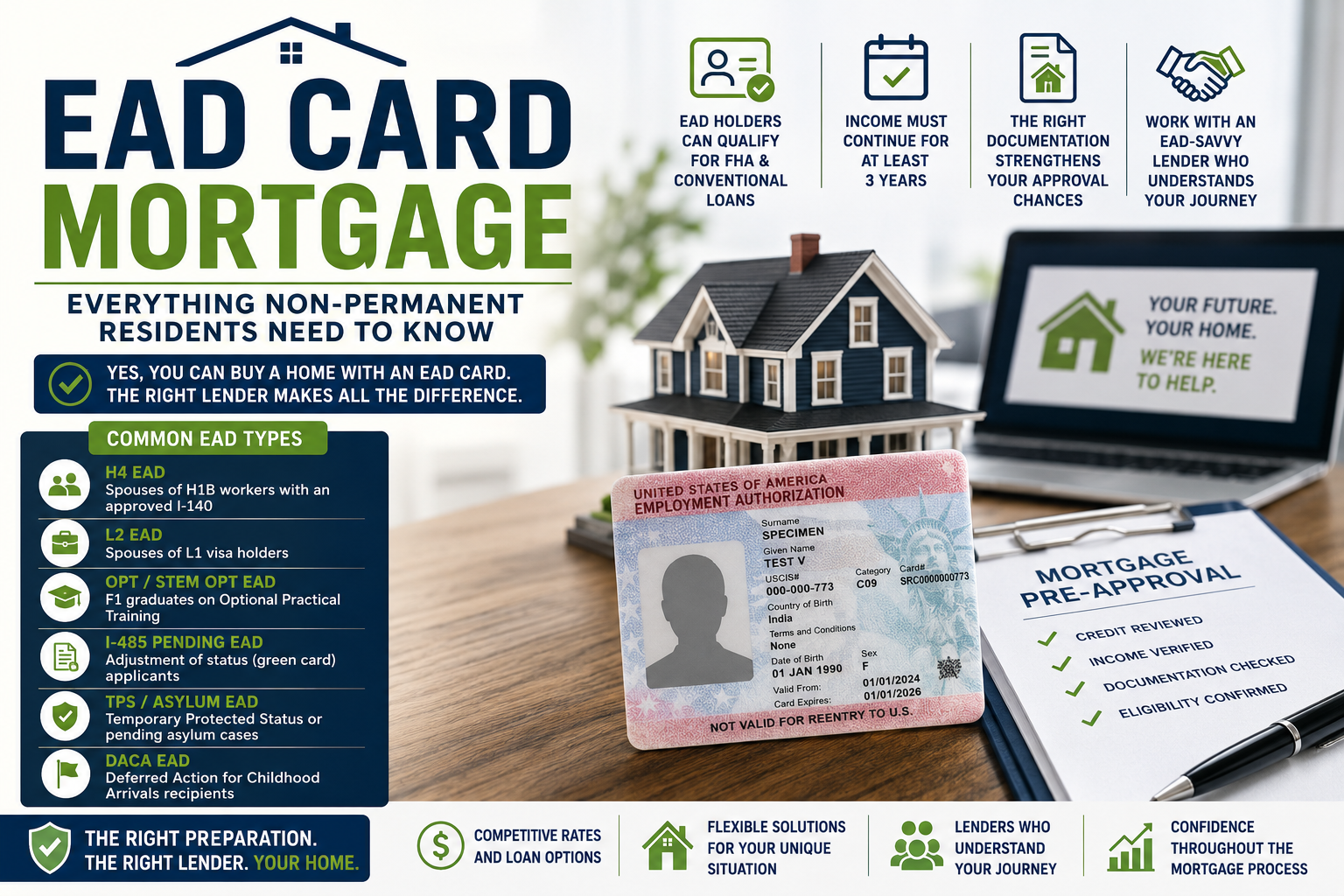
An EAD (Form I-766, Employment Authorization Document) is issued by USCIS to individuals who are authorized to work in the U.S. but are not permanent residents. Common EAD holders include:
- H4 EAD: Spouses of H1B workers whose H1B holder has an approved I-140
- L2 EAD: Spouses of L1 visa holders
- OPT EAD: Recent graduates on Optional Practical Training (F1 students)
- STEM OPT EAD: F1 graduates with a 3-year extension for STEM fields
- I-485 Pending EAD: Individuals who have filed for adjustment of status (green card application)
- Pending asylum or TPS EAD: Temporary Protected Status or pending asylum cases
- DACA EAD: Deferred Action for Childhood Arrivals recipients
Each category presents a different risk profile to mortgage lenders, and underwriters are trained (ideally) to distinguish between them.
Conventional and FHA Loan Eligibility for EAD Holders
The baseline answer is yes — EAD holders can qualify for both conventional and FHA loans under U.S. mortgage guidelines.
Conventional Loans (Fannie Mae/Freddie Mac)
Fannie Mae’s guidelines allow non-permanent residents — including EAD holders — to borrow under conventional guidelines. The key requirements:
- The borrower must be legally present in the U.S. (EAD satisfies this)
- The income must be eligible — legally earned U.S. income
- The income must be expected to continue for at least 3 years
That third point is where EAD type matters. A 1-year EAD has a natural expiration. The lender needs to assess whether that EAD will continue.
FHA Loans
FHA guidelines explicitly state that non-permanent resident aliens are eligible for FHA-insured mortgages. The borrower must have:
- A valid Social Security number
- Evidence of lawful presence in the U.S. (EAD satisfies this)
- U.S. income history
FHA is generally more accessible for first-time buyers due to its 3.5% down payment requirement and more flexible credit standards.
I-485 Pending + I-140 Approved: The Strongest Position
If you’re in the adjustment of status (AOS) process — meaning you’ve filed Form I-485 to get your green card — and your employer’s I-140 petition has been approved, you are in the most favorable position a non-permanent resident can be in for a mortgage.
Here’s why: An approved I-140 tells the underwriter that USCIS has already determined you are eligible for a green card. Your I-485 pending means your green card is in process. Even if it takes years for your priority date to become current (welcome to the Indian EB-2/EB-3 backlog), your legal status in the U.S. is essentially permanent pending processing.
Your EAD as an I-485 pending applicant is renewable and will be renewed until the I-485 is adjudicated. Lenders who understand this recognize that this borrower profile is essentially equivalent to a permanent resident for underwriting purposes.
Bring these documents:
- Form I-485 receipt notice
- I-140 approval notice (from employer’s petition)
- Current EAD card (Form I-766)
- EAD renewal receipt if current one is expiring
The 3-Year Continuance Rule in Practice
As mentioned, Fannie Mae requires that qualifying income have a reasonable expectation of continuing for 3 years. For EAD holders, here’s how this plays out by category:
I-485 Pending EAD: Strong continuance argument — AOS is a permanent process, and EADs renew until adjudicated.
H4 EAD: This one is tricky. H4 EADs are dependent on the H1B holder’s continued status and on the H1B holder having an approved I-140. If the I-140 is approved, H4 EAD is renewable indefinitely. If not, the H4 EAD situation is more tenuous. Lenders who understand this nuance will ask specifically about the H1B holder’s I-140 status.
OPT EAD: Standard OPT is 1 year. STEM OPT extends to 3 years. Even with STEM OPT, 3-year continuance is difficult to establish — the graduate must transition to an H1B or another status. Mortgages on OPT are harder but not impossible, especially with large compensating factors.
L2 EAD: Similar to H4 EAD, but L visas don’t have the I-140 pathway in the same way. L2 EAD holders are tied to the L1 holder’s status. Continuance depends on the underlying L1 petition remaining valid.
H4 EAD: Specific Considerations
The H4 EAD is one of the more common EAD types in the South Asian professional community — it’s what allows the spouse of an H1B worker to be employed.
Key facts for H4 EAD mortgage applicants:
- H4 EAD is only available if the H1B holder has an approved I-140. If the H1B holder doesn’t have an I-140 yet, the H4 spouse cannot have an EAD.
- The H4 EAD’s continuance is tied to the H1B holder’s continued status.
- If the H1B holder’s I-140 is approved, the H4 EAD situation is much stronger for lender purposes.
- If both spouses are co-borrowers on the mortgage (H1B holder + H4 EAD spouse), the file is stronger because you have two employment histories to document.
Pro tip for H4 EAD borrowers: If your H1B spouse is the primary earner, consider having them as the primary borrower and you as a co-borrower. The underwriter will anchor to the H1B holder’s income and immigration stability.
Documentation Checklist for EAD Mortgage Applications
Immigration Documents
- Current EAD card (Form I-766) — front and back
- All previous EAD cards if the lender asks for history
- I-485 receipt notice (if AOS process)
- I-140 approval notice (extremely valuable — include always if available)
- Passport (valid or expired — lenders sometimes need all pages)
- I-94 arrival/departure record (current entry)
- Supporting visa documents: I-797 if also holding H4 status; F1/I-20 if on OPT
Income and Employment Documents
- Employment letter on company letterhead, confirming position, salary, start date, and expected continuance
- Two years of W-2s (or as many as available with explanation)
- Two years of federal tax returns (1040)
- 30 days of recent pay stubs
Financial Documents
- Two months of bank statements (all pages)
- Investment/retirement account statements
Which Lenders Are EAD-Friendly
The EAD mortgage market has the same problem as the H1B mortgage market: many large lenders don’t properly train their loan officers on non-permanent resident files. The result is a lot of unnecessary declines.
EAD-friendly lenders:
- Have clear non-permanent resident mortgage programs
- Can articulate the specific documentation required for your EAD type
- Understand the difference between an I-485 pending EAD and an OPT EAD
- Know what an I-140 is and why it matters
If your loan officer doesn’t know what Form I-797 is, find a different loan officer.
DACA: An Honest Note
DACA (Deferred Action for Childhood Arrivals) recipients hold EAD cards and are eligible for conventional loans through Fannie Mae — Fannie Mae specifically updated its guidelines to allow DACA borrowers.
However, DACA’s legal and political status has been contested in courts, and some lenders apply overlays that exclude DACA borrowers due to the policy uncertainty. FHA loans are currently not available to DACA recipients under current HUD guidance.
If you’re a DACA recipient, you need a lender who explicitly participates in DACA lending and follows Fannie Mae guidelines without restrictive overlays. This is a real program — but it requires the right lender.
FAQ
Q: My EAD expires in 4 months. Can I still get a mortgage?
A: Possibly, but you need to be applying for renewal and have documentation of the renewal in progress. For I-485 pending EADs, renewal is nearly automatic. For other EAD types, timing matters. Talk to a lender who understands your specific situation.
Q: Can I be the sole borrower if I only have an EAD?
A: Yes. Your immigration status as an EAD holder doesn’t require you to have a co-borrower. However, if a co-borrower (such as your H1B spouse) improves the file, include them.
Q: My income is good but my EAD is an OPT. Realistic chances?
A: Harder than most EAD types due to the 1-year duration (or 3 for STEM OPT). Compensating factors — high credit score, 20%+ down payment, strong reserves — are essential. Consider waiting until H1B status is granted if your timeline allows.
Q: Does using EAD income affect the interest rate?
A: No. Your rate is determined by credit score, loan-to-value, property type, and market conditions — not immigration status.
Q: My I-485 was filed but my I-140 is not yet approved. Where do I stand?
A: More complicated. Without an approved I-140, the continuance of your AOS is harder to document. Some lenders will still work with this profile; others won’t. Be upfront with your lender about the exact stage of your immigration case.
Ready to get started? Masala Loans by Matador Lending specializes in exactly this. Call 713-366-4668 or get your no-haggle rate at masalaloans.com.
Matador Lending NMLS #1871433. Licensed in TX, FL (#MBR4588), GA (#69244), CA (#60DBO-112763).