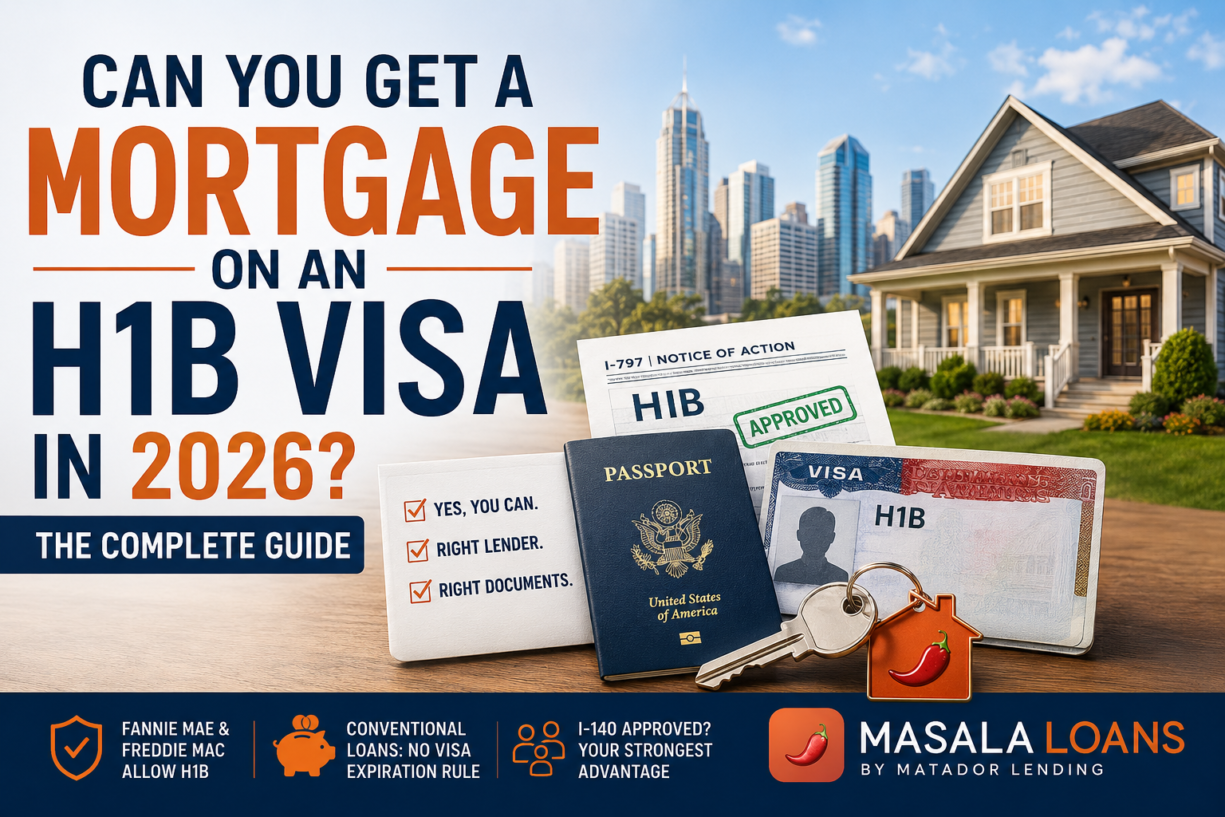
Can You Get a Mortgage on an H1B Visa in 2026? The Complete Guide
Yes. Full stop.
You can absolutely get a mortgage on an H1B visa in 2026. The idea that you need a green card or citizenship to buy a home in the United States is one of the most persistent myths in the South Asian community — and it has cost a lot of people years of unnecessary rent payments.
Fannie Mae, Freddie Mac, and the FHA all have clear guidelines that explicitly allow non-citizen, non-permanent residents to obtain home loans. H1B holders qualify. What you need is the right lender, the right documents, and a clear understanding of what underwriters are actually looking for.
This guide covers all of it.
The Short Answer: Why H1B Holders Can Get Mortgages
U.S. mortgage guidelines distinguish between three borrower categories:
- U.S. citizens — no immigration documentation needed
- Lawful permanent residents (green card holders) — treated almost identically to citizens
- Non-permanent residents — includes H1B, L1, O1, TN, and similar visa holders
H1B falls into category three. Fannie Mae and Freddie Mac (which back the vast majority of conventional loans) explicitly allow non-permanent residents to borrow, provided their income is legally sourced and they have a documented history of employment and residency in the U.S.
There is no law that prohibits a non-citizen from owning real estate in the United States. Lenders who tell you otherwise are either uninformed or simply don’t want the paperwork.
FHA Loans vs. Conventional Loans for H1B Borrowers
FHA Loans: The 1-Year Rule
FHA loans, backed by the Federal Housing Administration, require that your visa have at least one year remaining at the time of closing. If your visa expires in eight months, you’ll either need a renewal in hand or you’ll need to go conventional.
FHA also requires that the borrower has a history of U.S. residency. These loans allow down payments as low as 3.5% and are more forgiving on credit scores, but the mortgage insurance premiums (MIP) can add up over time.
For most H1B borrowers with solid income, conventional is often the better financial choice anyway.
Conventional Loans: No Visa Expiration Requirement
Here’s what most people don’t know: Fannie Mae and Freddie Mac have no requirement that your visa remain valid for a certain period after closing.
That’s right. Even if your H1B expires in six months, you can still close a conventional loan — as long as your lender is willing to document your situation properly and the underwriter is comfortable with the continuance of income.
What Fannie Mae does require is:
- Evidence you are legally present in the United States
- Evidence that your income is expected to continue for at least three years
That second point is where things get nuanced — and where the I-140 becomes important.
The 2-Year Employment History Rule
For conventional loans, lenders want to see a 2-year history of employment and income. For H1B holders, this typically means:
- Two years of W-2s from U.S. employers
- Two years of federal tax returns (Form 1040)
- Consistent employment — ideally with the same employer or within the same field
If you arrived on an H1B two years ago and have been employed consistently, you’re in good shape. If you just started your H1B this year, some lenders will decline you — but others will work with the income you have, especially if your offer letter is strong and your profile is otherwise clean.
New H1B holders in year one should focus on building their application around compensating factors: strong credit score (740+), larger down payment (10–20%), low debt-to-income ratio, and significant cash reserves.
The H1B Cliff Risk: What It Is and Why It Matters to Lenders
The “H1B cliff” refers to the scenario where your visa expires and you either lose your job, leave the country, or are unable to renew — meaning the lender’s collateral (your ability to repay the loan) suddenly disappears.
Lenders don’t like uncertainty. When an underwriter sees an H1B visa expiring in 12 months with no other immigration status, they start asking hard questions.
How Lenders Assess H1B Cliff Risk
Underwriters look at several factors:
- How long have you been in H1B status? The longer, the better.
- Is your employer a large, stable company? A Fortune 500 employer in a specialized tech role is far less risky than a small consulting firm.
- Is your H1B in a specialized, in-demand occupation? Software engineers, doctors, and engineers have vastly better renewal track records.
- What is your employer’s history with H1B renewals? Some lenders won’t say this out loud, but they notice.
The I-140 Approved Strategy: Your Best Mitigant
If your employer has filed an I-140 (Immigrant Petition for Alien Workers) on your behalf and it has been approved, this is the single most powerful document you can have in your mortgage file.
An approved I-140 tells the lender: this person is in the green card queue. Their employer has already petitioned for permanent residency. The likelihood of them becoming deportable in the near future is very low.
Even if your priority date is years away, an approved I-140 dramatically improves underwriter confidence in the continuance of your income and your legal presence. Many H1B borrowers who were initially declined elsewhere have gotten approved once they provided their I-140 approval notice.
If your I-140 is pending (not yet approved), it still helps — but it’s not the same level of reassurance.
Which Lenders Are H1B-Friendly (And Which Aren’t)
This is where the South Asian community gets burned the most. You walk into a big bank branch, the loan officer doesn’t know H1B guidelines, and you walk away with a decline. You assume it’s impossible.
It’s not. You just went to the wrong lender.
H1B-unfriendly lenders tend to:
- Require a green card as an unstated policy
- Have underwriters who’ve never processed a non-permanent resident file
- Apply their own overlays (additional requirements beyond Fannie/Freddie guidelines) that exclude H1B
H1B-friendly lenders tend to:
- Specialize in or actively market to immigrant communities
- Have underwriters who understand I-94, I-797, and I-140 documentation
- Follow Fannie/Freddie guidelines as written, without unnecessary overlays
- Be able to explain exactly what documentation they need and why
Specialty lenders who serve the South Asian and immigrant professional community — like MasalaLoans by Matador Lending — exist precisely because the big banks often drop the ball on these files.
Required Documents for an H1B Mortgage
Visa and Immigration Documents
- Valid passport (all pages, even blank ones — some lenders request this)
- Current visa stamp in passport (H1B or H1B1)
- I-94 arrival/departure record (download from cbp.gov — most recent entry)
- I-797 approval notices (all of them — initial approval, all extensions)
- I-140 approval notice (if applicable — include it even if not requested)
Employment and Income Documents
- Employment verification letter on company letterhead, signed by HR, stating your title, start date, salary, and that your employment is expected to continue
- Two years of W-2s
- 30 days of recent pay stubs
- Two years of federal tax returns (1040)
Financial Documents
- Two months of bank statements (all pages — yes, the blank ones too)
- Investment and retirement account statements
Real Scenarios: Three H1B Borrowers
Scenario 1: New H1B Holder (Year 1)
Priya arrived on her H1B in January 2025. She has a $180,000 salary at a tech company in Austin. She has 8 months of U.S. employment history.
Reality: Harder, but not impossible. Most conventional lenders want 2 years. However, if Priya has strong credit (760+), 15-20% down, and compensating factors, some lenders will accept her foreign income history combined with her U.S. income. An H1B-specialist lender is essential.
Scenario 2: H1B with I-140 Approved
Rajesh has been on H1B for 4 years. His company filed his I-140 two years ago and it was approved. His priority date is still years out, but he has the approval notice.
Reality: This is the strongest possible position for an H1B borrower. Most lenders comfortable with non-permanent residents will approve this file. Conventional loan, standard rates.
Scenario 3: H1B Extension Pending
Kavya’s H1B extension was filed 4 months ago and she’s currently working on the I-797 receipt notice (proof it was filed). Her visa stamp expired while the extension is pending.
Reality: She can still work legally and stay in the U.S. — but lenders need to see the I-797 receipt. Some will wait for the approval before closing. Others, familiar with H1B rules, will close with the receipt notice. Know your lender.
FAQ
Q: Can I get a mortgage in my first year on H1B?
A: Yes, but it’s harder. You’ll need compensating factors: strong credit score, larger down payment, low debt, and a lender who specializes in H1B files. Some lenders require a 2-year U.S. employment history; others will work with foreign income history to bridge the gap.
Q: Does my H1B visa need to be valid at closing?
A: For FHA, yes — at least one year remaining. For conventional (Fannie Mae/Freddie Mac), there is no such hard requirement, though the lender must document the likelihood of income continuance.
Q: Does having an approved I-140 change my interest rate?
A: No. The I-140 helps you get approved, but it doesn’t affect your rate. Your rate is based on credit score, loan-to-value ratio, loan type, and market conditions.
Q: What if my employer won’t write a letter confirming continued employment?
A: Many large employers have HR policies against providing such letters. In that case, ask HR for what they can provide — often a letter confirming employment and salary without a forward-looking statement. Lenders deal with this regularly and have workarounds.
Q: Is buying a home on H1B a good idea given the current immigration environment?
A: That’s a personal decision, but financially, the math usually favors buying for anyone planning to stay 3+ years. Real estate in Texas, Florida, Georgia, and California has historically appreciated. Renting while waiting for a green card that may take 10+ years often means missing significant wealth-building opportunity.
Ready to get started? MasalaLoans by Matador Lending specializes in exactly this. Call 713-366-4668 or get your no-haggle rate at masalaloans.com.
Matador Lending NMLS #1871433. Licensed in TX, FL (#MBR4588), GA (#69244), CA (#60DBO-112763).